About Awalyt
An investment analysis platform
for portfolios built on data, not opinions.
Backtesting, asset analysis, fundamental research, and live portfolio monitoring, all in one place. With an AI layer that reads only what the engine has calculated, never invents.
Why we built Awalyt
There's a pattern that shows up every time markets turn rough. When things are calm, your portfolio is something you barely check. When the market drops 20% in three weeks, your portfolio is suddenly everything. You read more, you doubt more, you reach for opinions. And in those moments, when fear is loudest and conviction is thinnest, most investors do the worst thing possible: they sell, near the bottom, against the long-term plan they wrote down two years earlier.
The reason isn't that investors are irrational. It's that very few of them ever build a method. Without a strategy you can verify and a portfolio you actually understand, every drawdown feels new. So you turn to the loudest source nearby: a Reddit thread, a financial YouTuber, a media headline, ChatGPT explaining your portfolio with confident punctuation. None of those sources is built to be right. Most have incentives that have nothing to do with your money.
I started building Awalyt because every option I had was broken in a different way. Free tools used monthly data and quietly understated risk. Professional tools cost thousands and assumed you came from a Bloomberg terminal. AI tools invented numbers with the same tone they used for real ones. Spreadsheets stopped scaling at the fifth ETF and broke at the tenth. The components I needed existed; they just sat on five different platforms that didn't talk to each other.
Awalyt brings those components into one platform. Daily-precision backtesting, fundamental analysis on real SEC filings, statistical analysis of individual assets, live monitoring of the portfolio you actually own, and an AI layer that explains the numbers our engine has calculated instead of inventing its own. Built for investors who want a method, and for advisors who need to show their clients one.
How Awalyt works
Awalyt is built around four analytical modules and one AI layer that sits across all of them. The modules do the heavy work: Backtesting on 10+ years of daily data, Asset Analysis on how individual instruments behave, Fundamental Analysis on companies through their actual financials, Portfolio Monitoring on the portfolio you really own. The AI layer reads only what the engine has calculated, then explains what those numbers mean in plain language.
Module 1
Backtesting: test the strategy before you commit the money
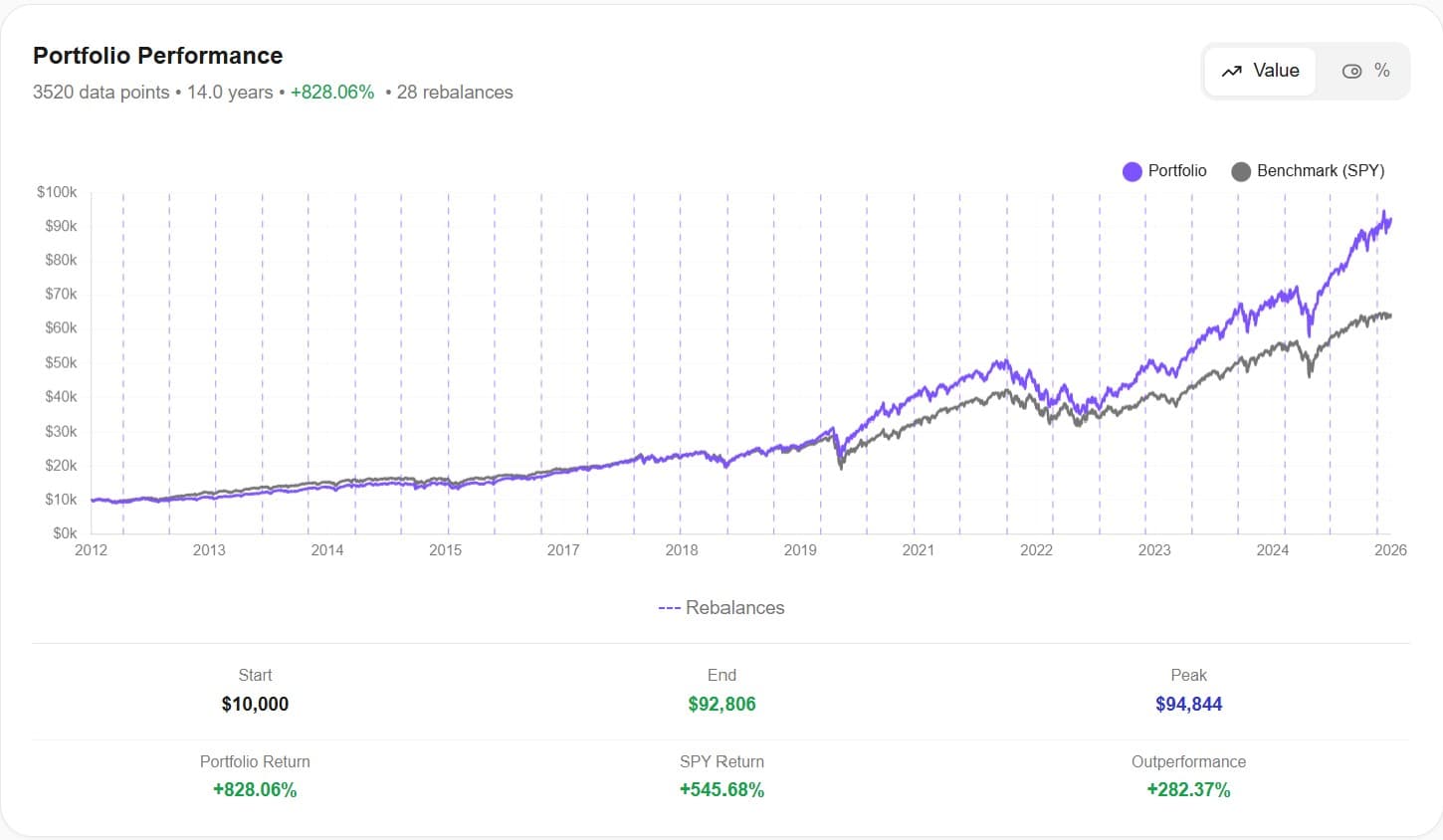
Backtesting in Awalyt runs on 10+ years of daily-precision data: 252 data points per year, where most free tools use 12. The difference matters in the metrics that decide whether you actually hold a portfolio through a crisis. A monthly-data tool will tell you that 2020 closed at +17%. Awalyt will show you that the same year had a -34% drawdown in five weeks, because daily data sees what monthly averaging quietly smooths over.
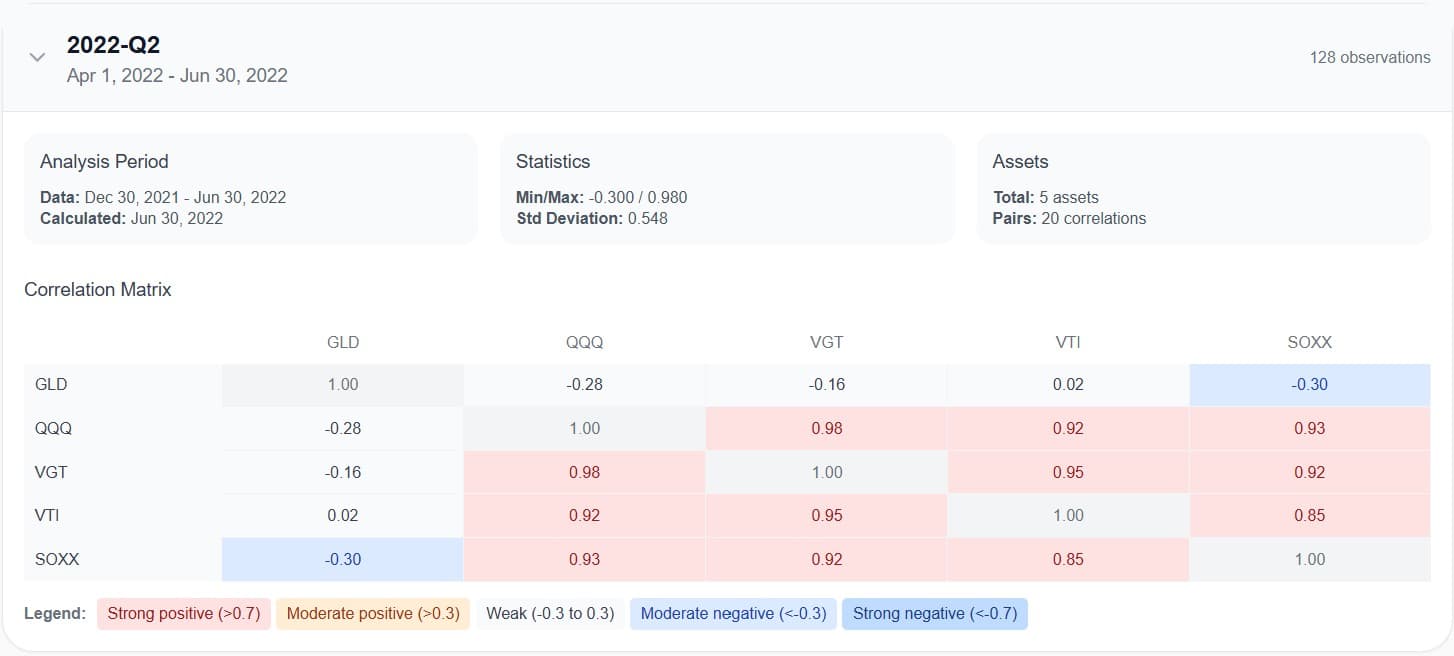
You define a portfolio, pick a time range, choose a rebalancing strategy. The engine simulates everything day by day, dividends reinvested, rebalancing trades executed as you specified. The output is the full picture: total return, CAGR, Sharpe, real max drawdown, volatility, side-by-side comparison versus SPY. And the engine also calculates the correlation matrix of the portfolio you just tested, quarter by quarter across the entire period, so you can see how the diversification of that specific strategy actually held up over time.
Module 2
Asset Analysis: how an instrument actually behaves
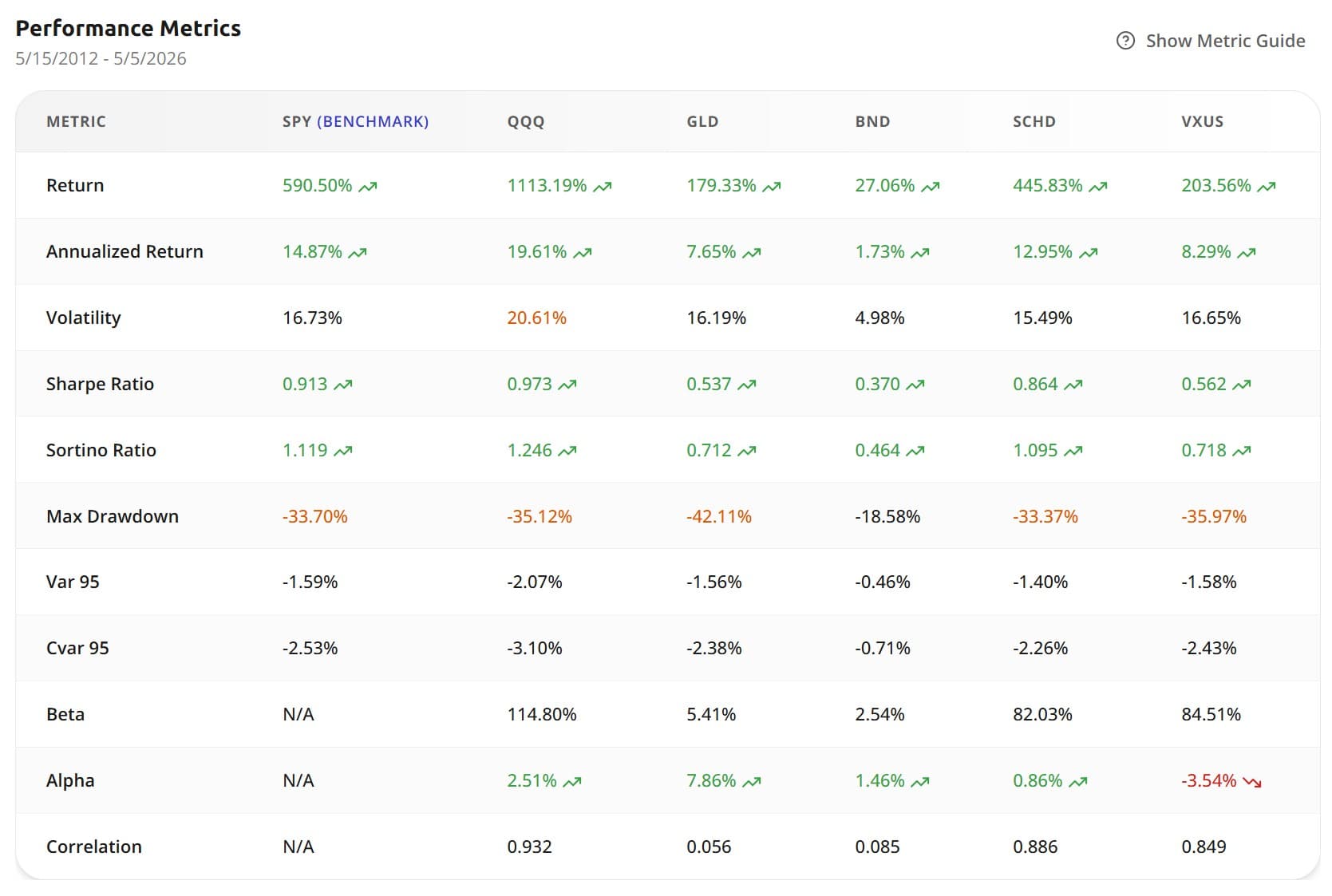
Asset Analysis studies a single instrument (a stock, an ETF, a fund) by its price behavior over time. Not its fundamentals, not its story, but how it actually moves. Volatility, drawdowns, Sharpe and Sortino ratios, beta and alpha relative to a benchmark, correlation against any other asset you put alongside it. The same engine that powers our backtests calculates these metrics on the same daily data, going back as far as the asset's history allows.
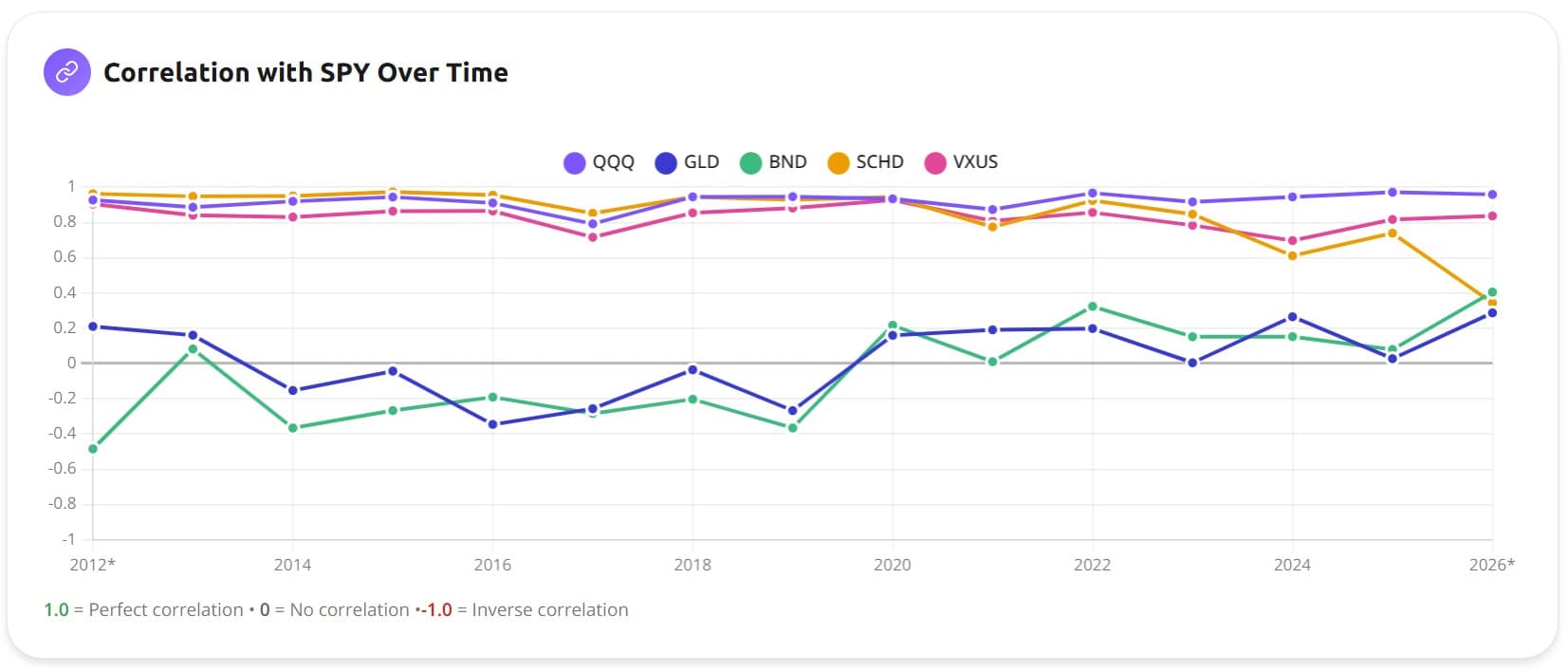
Where most tools give you a single correlation number averaged across the entire history, Awalyt shows you how that correlation has evolved year by year. This matters because correlations are not stable. BND was negatively correlated with SPY for most of the post-2008 era; in 2022, that flipped, and the bonds that were supposed to hedge stocks fell alongside them. Seeing the shift on a chart, instead of one number averaged across 14 years, makes the difference between knowing your hedge and assuming it.
Module 3
Fundamental Analysis: judge the business behind the ticker
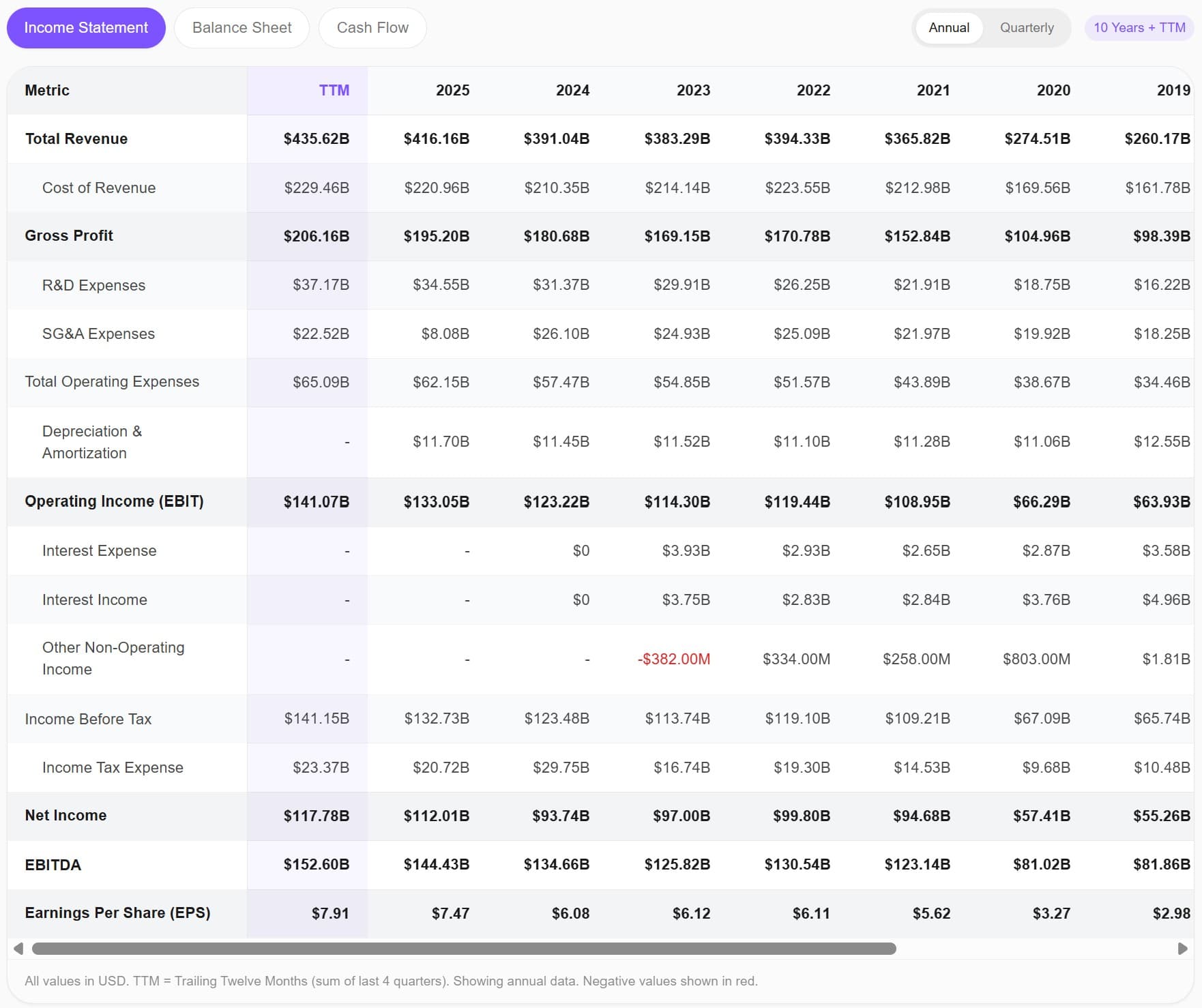
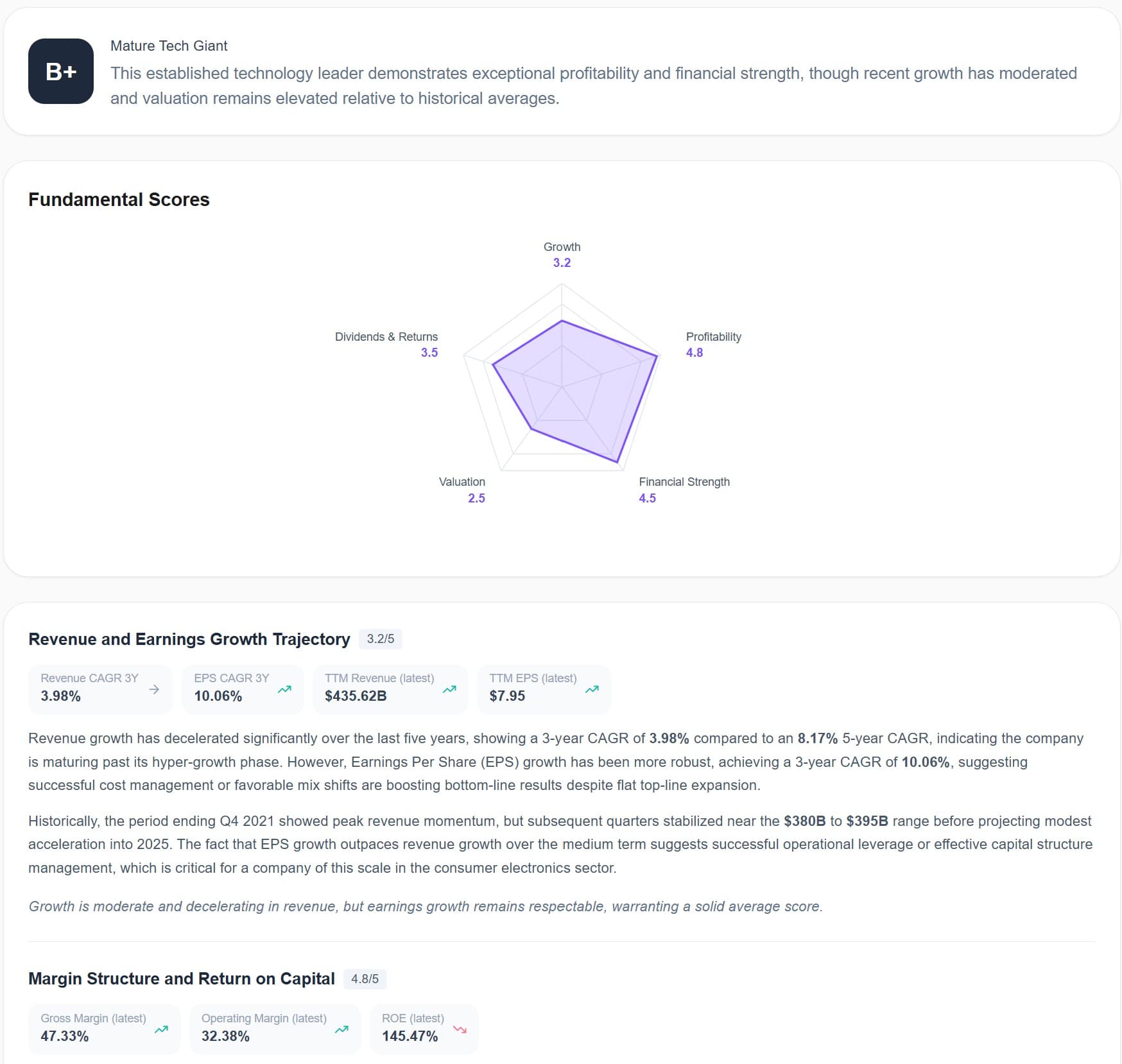
Fundamental Analysis looks at the company behind a stock, the actual business, using ten years of financial statements pulled directly from SEC filings. Income statement, balance sheet, cash flow, valuation ratios, profitability margins, growth trajectories, all annotated quarter by quarter. The point isn't to tell you whether a stock is "good" or "bad". It's to give you the numbers a serious analyst would want, in a format you can read in five minutes instead of fifty.
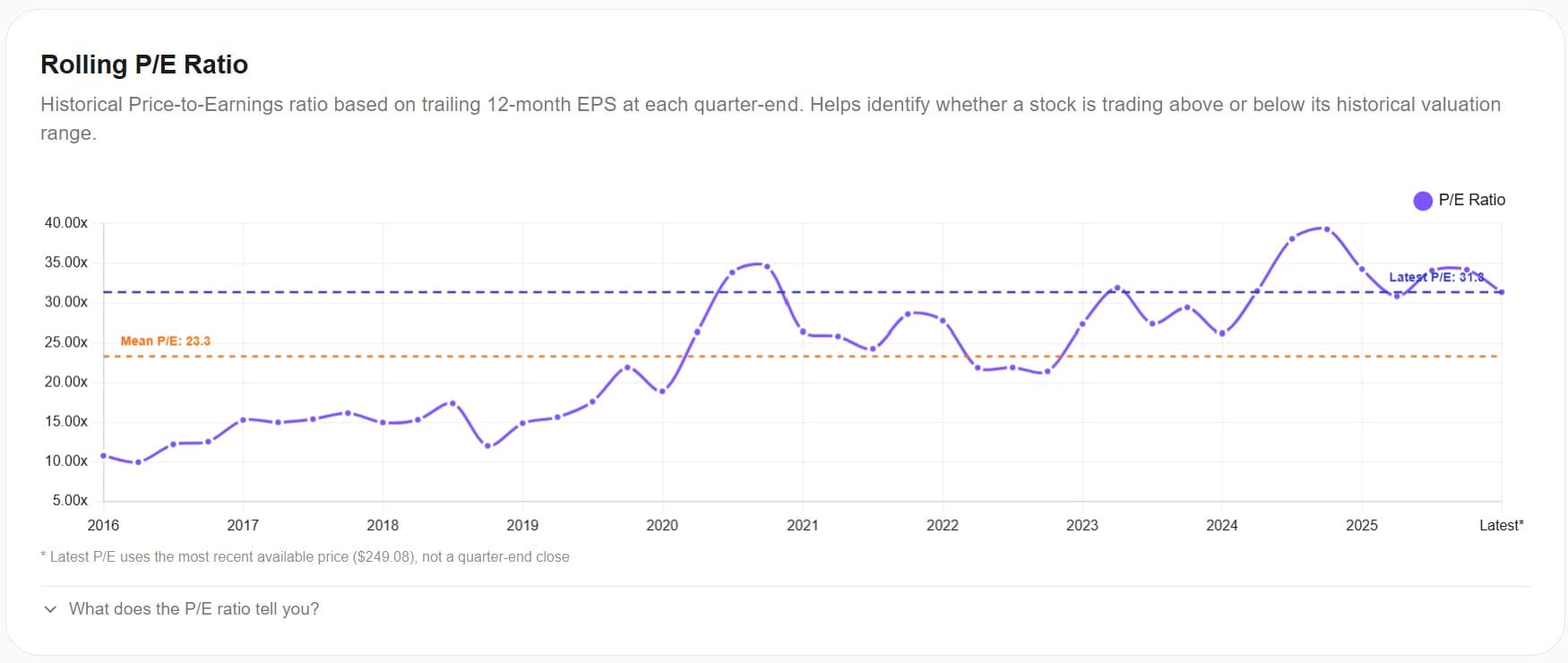
The single most underused piece of fundamental analysis at retail level is historical context. A P/E of 31 sounds high in the abstract; it reads differently once you can see that the same company has traded between 10 and 35 over the last decade, with a mean of 23. Awalyt's rolling P/E view plots that history quarter by quarter, so you can see where today actually sits relative to where the stock has been valued before. The same approach extends to margins, growth, and cash flow.
Module 4
Portfolio Monitoring: what you actually own, with the analysis it deserves
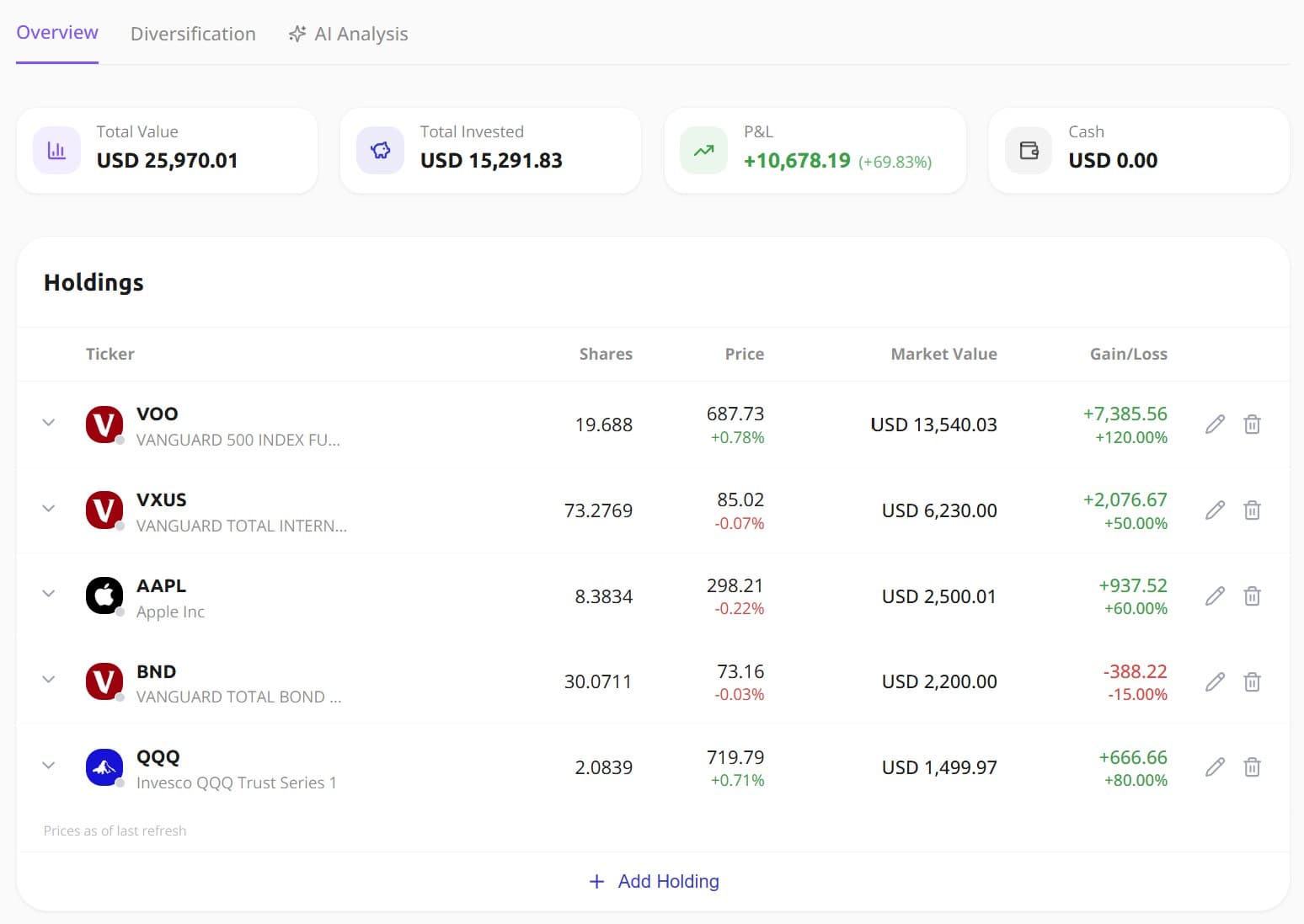
This is the one module that touches your actual money. You import your holdings, manually or by uploading your broker's export, and Awalyt maintains a live view: prices, daily change, market value, gain/loss per position. Time-weighted return so you can see the actual performance of your strategy, separate from the noise of deposits and withdrawals. Historical snapshots so you can look back at how your portfolio looked six months or two years ago, not just today.
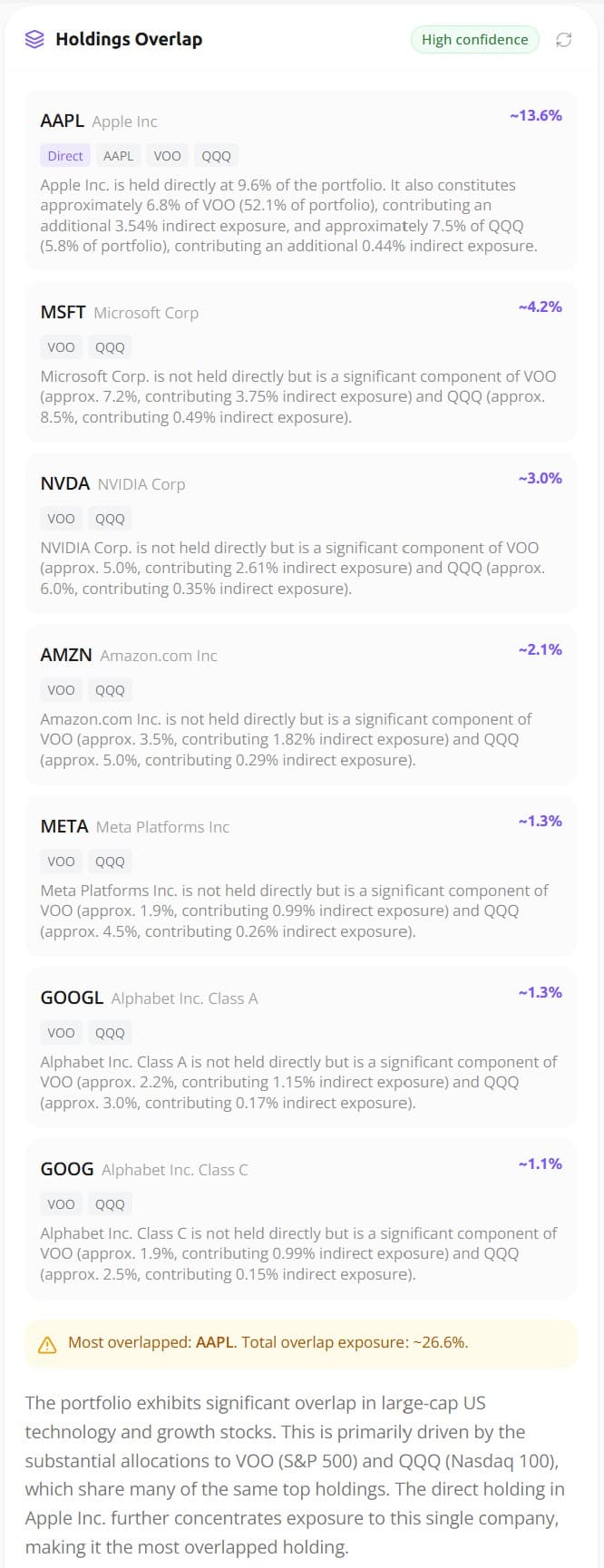
What sets it apart isn't the tracking. Most brokers do that. It's the analysis the engine runs on your real portfolio. Holdings overlap across ETFs and direct stock positions: if you hold VOO, QQQ, and AAPL directly, you don't own three separate bets, you own Apple at roughly 14% across all three. Sector and geographic exposure summed across the whole portfolio. Concentration metrics. And the AI explaining what the numbers actually mean for the risk you're carrying, in language a client could read.
The transversal layer
The AI layer: explanation, not opinion
There's a recent shift in how investors use AI. People increasingly ask ChatGPT or similar tools whether their portfolio is diversified, whether a stock is overvalued, whether they should hold or sell. The answers come back confident and well-written. They're also, often, made up: built on partial data, no context, and a training set that doesn't know your actual holdings or the actual current price of anything.
We don't think AI is the problem. We think AI without grounded data is. With an engineering background, we approached this layer the same way we would approach any system: an AI is only as reliable as its inputs. Inside Awalyt, the AI doesn't read the internet, doesn't draw from training memory, and doesn't generate financial figures on its own. It reads only what our engine has calculated: a backtest you just ran, a correlation matrix from your portfolio, the rolling P/E we computed from SEC filings. Then it explains what those numbers mean in plain language.
The boundary matters. The AI is there to make analysis faster, not to replace it. You still have to think about your strategy, your horizon, your risk tolerance. The AI surfaces what's worth looking at and contextualizes it. The decision stays with you.
Who Awalyt is for
Awalyt is built for people who manage portfolios of ETFs and stocks with a long-term horizon and want to base decisions on verifiable analysis instead of on whoever shouted loudest this week. Bogleheads-style passive investors checking whether their three-fund allocation actually does what they think it does. Multi-ETF builders verifying that "VOO + QQQ + SCHD" diversifies in any meaningful sense. Stock pickers running fundamentals on individual names and backtesting the resulting portfolio in one place.
It's also built for independent financial advisors who need to verify their own strategies against history and present them to clients with analysis the client can read. The same backtests and analyses that an individual investor uses are exportable into views that work in a client meeting.
It is not built for day traders, signal services, or anyone who wants to be told what to buy this week. There are tools for that. Awalyt isn't one of them.
What makes Awalyt different
Daily-precision data
The single most important methodological choice we made. Monthly data understates max drawdown by 10 to 15 percentage points in volatile periods and understates realized volatility by 20 to 30%. Our backtests show you the risk you would have actually lived through, not a smoothed version of it.
AI that can't hallucinate financial figures
Because the AI doesn't generate numbers, only explains the ones our engine has calculated, there's nothing for it to invent. Any figure it cites traces back to an underlying calculation you can verify.
One platform, not five
Most serious portfolio analysis today requires switching between a backtesting tool, a fundamentals database, a charting platform, and a portfolio tracker. We built Awalyt because the workflow shouldn't require five subscriptions and four browser windows.
Where we are today
Awalyt is open. All four modules and the AI layer are live and in active use. There's a Free plan — free forever, no credit card — and a Premium plan with everything included. No separate tier, no add-on for the AI layer, no per-module pricing.
Want to see how we apply this in practice? We use Awalyt's tools in our research blog.