Does Gold Improve Portfolio Returns? [Backtest]
Key Takeaways
- Adding 20% gold to a growth-tilted portfolio improved Sharpe ratio by 12% and reduced max drawdown by 18%
- The trade-off: ~0.7% lower annual returns (12.23% vs 12.92% CAGR)
- Gold's value comes from low correlation with equities—especially during market crashes
- Best for: investors approaching retirement, those prone to panic-selling, or anyone prioritizing risk-adjusted returns
- Skip gold if: you're young with 30+ year horizon and can truly ignore volatility
The Reddit Portfolio That Started This Analysis
A question on r/ETFs caught our attention: an 18-year-old investor shared their proposed portfolio and asked for feedback. The allocation was textbook diversification—50% VOO, 20% VXUS, 20% QQQM, and 10% AVUV.
The comments exploded with opinions. Some praised it. Others suggested VTI over VOO. A few called QQQM "nonsense."
Here's the problem with investment advice on Reddit: it's mostly opinion, rarely backed by data.
So we ran the numbers. We backtested multiple portfolio variations over 15 years, including one modification nobody in that thread suggested: adding gold for portfolio diversification.
The results challenge conventional wisdom about chasing maximum returns.
Three Portfolios We Backtested
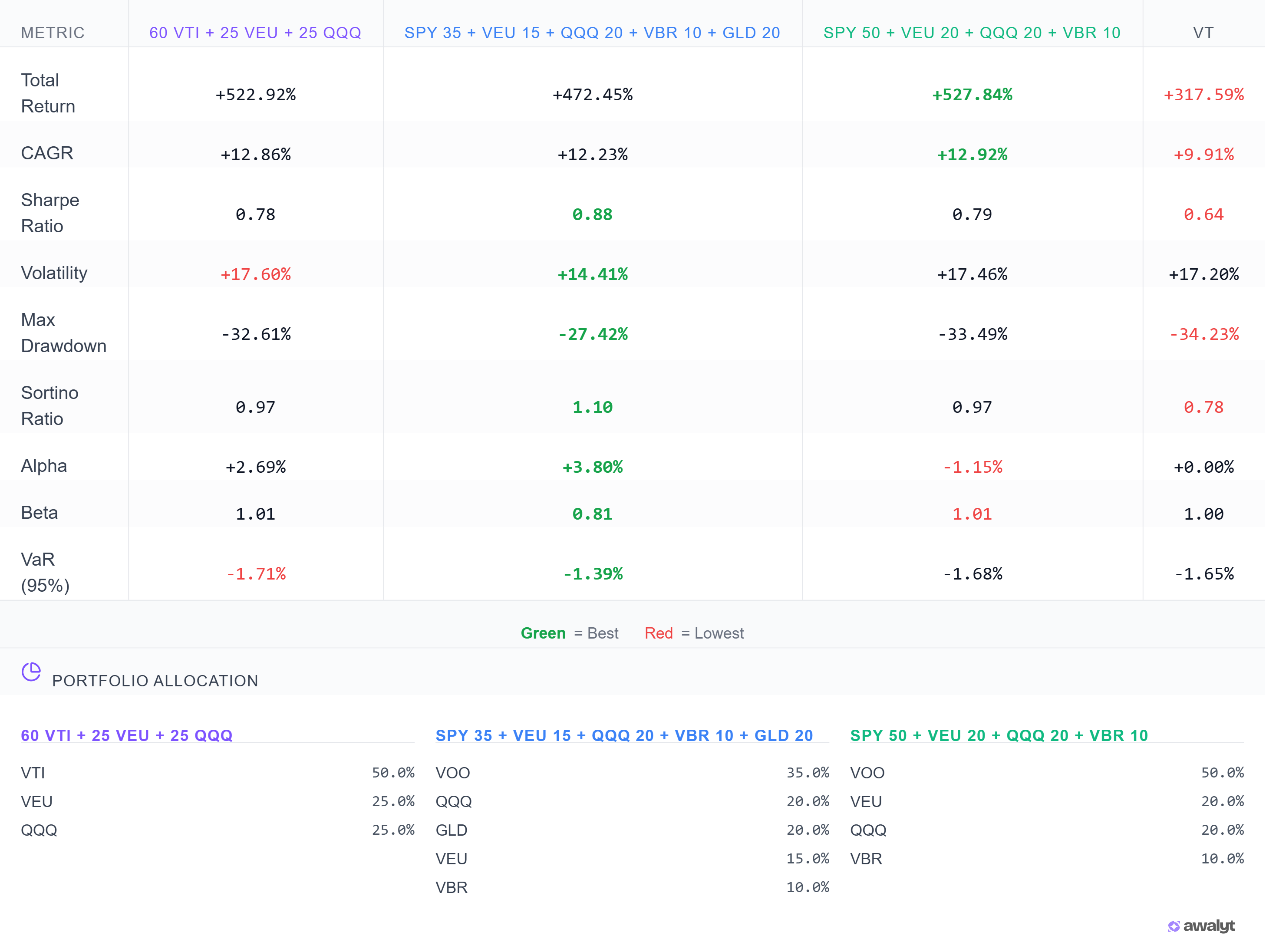
We analyzed three allocations from October 2010 to November 2025 (15.1 years), using ETFs with longer track records:
Portfolio 1: Reddit Original
- 50% SPY (S&P 500)
- 20% VEU (International ex-US)
- 20% QQQ (Nasdaq-100)
- 10% VBR (Small Cap Value)
Portfolio 2: Reddit Alternative (more international exposure)
- 60% VTI (Total US Stock Market)
- 25% VEU (International ex-US)
- 25% QQQ (Nasdaq-100)
Portfolio 3: Gold-Enhanced
- 35% SPY (S&P 500)
- 15% VEU (International ex-US)
- 20% QQQ (Nasdaq-100)
- 10% VBR (Small Cap Value)
- 20% GLD (Gold)
All portfolios rebalanced every 6 months using constant-mix strategy. Benchmark: VT (Vanguard Total World Stock).
Raw Returns: Gold "Lost"
Let's start with what most investors check first—total returns.
| Portfolio | Total Return | CAGR |
|---|---|---|
| Reddit Original | +527.84% | 12.92% |
| Reddit Alternative | +522.92% | 12.86% |
| Gold-Enhanced | +472.45% | 12.23% |
| VT Benchmark | +317.59% | 9.91% |
At first glance, Reddit Original wins. $10,000 invested in October 2010 became $62,784. The gold portfolio? "Only" $57,245—about $5,500 less.
Case closed? Gold dragged down returns?
Not so fast.
Risk-Adjusted Metrics Tell a Different Story
Returns measure how much money you made. Risk-adjusted metrics measure how efficiently you made it.
Sharpe Ratio: Return Per Unit of Risk
The Sharpe ratio answers: "How much return am I getting for each unit of risk?"
| Portfolio | Sharpe Ratio |
|---|---|
| Gold-Enhanced | 0.88 |
| Reddit Original | 0.79 |
| Reddit Alternative | 0.78 |
| VT Benchmark | 0.64 |
The gold portfolio delivers 12% higher Sharpe ratio. You're getting more return per unit of risk. This efficiency compounds dramatically over decades.
Sortino Ratio: Downside Risk Focus
The Sortino ratio focuses specifically on downside volatility—the moves that actually hurt.
| Portfolio | Sortino Ratio |
|---|---|
| Gold-Enhanced | 1.10 |
| Reddit Original | 0.97 |
| Reddit Alternative | 0.97 |
| VT Benchmark | 0.78 |
Gold isn't just reducing overall volatility—it's specifically reducing the painful drops that keep investors up at night. 13% improvement over equity-only portfolios.
Maximum Drawdown: The Sleep-at-Night Factor
This measures the largest peak-to-trough decline. It determines whether you can stick with your strategy when markets crash.
| Portfolio | Max Drawdown |
|---|---|
| Gold-Enhanced | -27.42% |
| Reddit Alternative | -32.61% |
| Reddit Original | -33.49% |
| VT Benchmark | -34.23% |
During the worst period, the gold portfolio lost 27.42%. Reddit Original lost 33.49%—6 percentage points more.
Put this in dollar terms: on a $500,000 portfolio, that's the difference between dropping to $363,000 versus $332,500. That extra $30,000 cushion could mean the difference between staying invested and panic-selling at the worst time.
Volatility Comparison
| Portfolio | Volatility |
|---|---|
| Gold-Enhanced | 14.41% |
| VT Benchmark | 17.20% |
| Reddit Original | 17.46% |
| Reddit Alternative | 17.60% |
17% lower volatility means smaller daily and monthly swings. Easier to stay the course during turbulent markets.
Alpha and Beta
| Portfolio | Alpha | Beta |
|---|---|---|
| Gold-Enhanced | +3.80% | 0.81 |
| Reddit Alternative | +2.69% | 1.01 |
| Reddit Original | -1.15% | 1.01 |
| VT Benchmark | 0.00% | 1.00 |
The gold portfolio generated positive alpha of 3.80%—outperforming what market exposure alone would predict. Its beta of 0.81 means less sensitivity to market swings.
This combination is powerful: excess returns while taking less systematic risk.
Why Gold Works: The Correlation Effect
Gold improves risk-adjusted returns because of its low and dynamic correlation with equities.
We analyzed rolling 6-month correlations across multiple market conditions:
Normal Markets (2014)
- GLD vs QQQ: -0.64
- GLD vs VOO: -0.38
- GLD vs VBR: -0.38
Calm Markets (2018 Q2)
- GLD vs QQQ: 0.05
- GLD vs VOO: 0.06
- GLD vs VBR: 0.09
Crisis Conditions (2020 COVID Crash)
- GLD vs VBR: -0.51
- GLD vs VEU: -0.37
- GLD vs VOO: -0.05
During the COVID crash, gold maintained negative correlations with the assets getting hammered hardest. When small-cap value and international stocks crashed, gold provided ballast.
The Key Insight
Gold doesn't behave predictably—and that's the point. Its correlations shift based on what's driving markets:
- Recession fears: Gold rises as safe haven
- Tech corrections: Gold neutral
- Inflation scares: Gold outperforms
- Dollar weakness: Gold strengthens
This dynamic behavior makes gold an effective diversifier. Unlike bonds—which have become increasingly correlated with stocks—gold maintains diversification benefits across different market regimes.
The Real Trade-Off
Let's be honest: adding gold costs you raw returns.
Over 15 years, the gold portfolio returned 472.45% versus 527.84%—about 55 percentage points less, or 0.7% lower CAGR.
Is that trade-off worth it?
When Gold Makes Sense
Approaching retirement (10-15 years out): Sequence-of-returns risk becomes crucial. A smaller drawdown at the wrong time can permanently impair your retirement.
You'll panic-sell in crashes: Be honest. If watching your portfolio drop 33% would make you sell, you're better off with a smoother ride. The best portfolio is one you can stick with.
You value sleep over spreadsheets: The psychological benefit of lower volatility is real. A portfolio that lets you ignore market noise has value that doesn't show up in returns.
Building true diversification: Modern portfolio theory shows combining uncorrelated assets improves risk-adjusted returns. Gold is one of the few assets that maintains genuine diversification benefits.
When To Skip Gold
You're young with decades ahead: At 25 with a 40-year horizon, extra volatility is easier to stomach. Higher expected returns compound more.
You truly won't check your portfolio: If you can genuinely set-and-forget, volatility costs nothing psychologically. Take the higher expected return.
Already diversified elsewhere: Real estate, stable job, or other uncorrelated assets might mean you don't need gold in your investment portfolio.
What Reddit Missed
The original poster's diversification instinct was sound. All three portfolios crushed the VT benchmark by 3+ percentage points annually.
Reddit was also right that VTI vs VOO is a marginal decision.
But here's what the entire discussion missed: the role of non-correlated assets.
Every suggestion in that thread—VOO, VTI, VXUS, VEU, QQQ, QQQM, AVUV, VBR—is an equity fund. They're all substantially correlated, especially during crashes when diversification matters most.
Nobody mentioned gold. Nobody suggested bonds. Nobody brought up commodities or REITs.
This is retail investing's blind spot. We optimize endlessly within equities—large vs small, growth vs value, US vs international—while ignoring asset allocation decisions that actually move the needle on risk-adjusted returns.
How To Add Gold to Your Portfolio
If you're convinced gold makes sense, here's the practical implementation:
ETF Selection: GLD (SPDR Gold Trust) is most liquid. IAU (iShares Gold Trust) is cheaper—0.25% vs 0.40% expense ratio. Both work well.
Allocation Size: Our backtest used 20%, which is aggressive. Academic research suggests 5-15% as optimal for risk reduction. Start smaller if uncertain.
Rebalancing: Semi-annual rebalancing (every 6 months) captures the benefit of buying low without excessive trading costs.
Tax Considerations: Gold ETFs are taxed as collectibles (28% federal rate) versus 15-20% for long-term capital gains. This makes gold more attractive in tax-advantaged accounts (IRA, 401k).
The Bottom Line
The Reddit portfolio wasn't bad—it significantly outperformed a global index fund. But adding 20% gold achieved:
- 12% higher Sharpe ratio (0.88 vs 0.79)
- 13% higher Sortino ratio (1.10 vs 0.97)
- 18% smaller maximum drawdown (-27.42% vs -33.49%)
- 17% lower volatility (14.41% vs 17.46%)
- Positive alpha (+3.80% vs -1.15%)
The cost: about 55 percentage points in total return over 15 years.
The question isn't whether gold "beats" stocks. Over the long term, equities deliver higher returns. The question is whether improved risk characteristics help you stay invested through inevitable downturns—and whether that peace of mind is worth something to you.
For many investors, especially those approaching retirement or prone to emotional decisions, the answer is yes.
FAQ
How much gold should I have in my portfolio?
Academic research suggests 5-15% for optimal risk reduction. Our backtest used 20%, which is on the higher end. Start with 5-10% if you're uncertain.
Is GLD or IAU better for gold exposure?
Both track physical gold effectively. IAU has lower expense ratio (0.25% vs 0.40%), making it slightly better for long-term holding. GLD has higher liquidity, better for larger trades.
Should I hold gold ETFs in a taxable or retirement account?
Gold ETFs are taxed as collectibles at 28%, higher than long-term capital gains rates. Hold gold in tax-advantaged accounts (IRA, 401k) when possible.
Does gold protect against inflation?
Historically, gold has performed well during inflationary periods, but correlation isn't perfect. Gold's primary portfolio benefit is low correlation with equities, not direct inflation hedging.
How often should I rebalance a portfolio with gold?
Semi-annual (every 6 months) or annual rebalancing works well. More frequent rebalancing increases costs without significantly improving results.
This analysis was performed using Awalyt's portfolio backtesting platform with daily data precision. All portfolios were rebalanced semi-annually using constant-mix strategy. Past performance does not guarantee future results.
Want to test your own portfolio ideas? Run different allocations, rebalancing frequencies, and time periods to see how they would have performed. Sometimes the best investment decision is the one you can actually stick with.
Want to test these insights on your own portfolios?
Awalyt is a portfolio analysis platform: backtesting on daily data, fundamental analysis, asset analysis, and AI-powered insights.
Get Started FreePortfolios mentioned in this article
Related Insights
60/40 vs 80/20 vs 90/10: VOO/BND Backtest Results (15 Years) [2026]
8 min read
60/40 vs 70/30 vs 80/20: VTI/VXUS Backtest Results (14 Years)
7 min read
Does VTI Make SCHD Redundant? A Data-Driven Analysis [2026]
9 min read
SPY vs VOO vs IVV: Which S&P 500 ETF Should You Pick? [2026]
10 min read
SCHD vs VYM vs VIG: 14-Year Backtest — Which Dividend Strategy Actually Wins?
12 min read
SCHD vs DGRO vs VYM vs HDV vs SPYD: 10-Year Backtest [2026]
12 min read